I am going to narrate the story of Heemal–Naagrai to you, but before I start, I want to tell you a few things about attar. I hope you are familiar with attar. If you are not, an attar (also ittar or itr or—as we commonly pronounce it in Koshur—aeter) is a fragrant essential oil derived from biological sources. Ataar (people who are experts in making attar) distill the essence of a flower, an organ of the body of an animal, a leaf, even wet earth (from which itr-e-gil is allegedly made) and mix them with appropriate substances to make them last longer at room temperature and to dilute their strong, nausea-inducing smell (even pleasant aromas can be sickening if they are too strong, which only proves that, as my mother is fond of saying, excess of everything is bad). Once ready, attars are used to give human bodies, buildings, or animals an agreeable scent. They are generally applied on clothes for aromatic purposes.
But what has the making of attar got to do with the story of Heemal–Naagrai, you may ask. A just question. Well, the two can be coupled through an extended metaphor. The story of Heemal–Naagrai is part of the Koshur folklore, and folklore is the attar of culture. As the essential fragrance of flowers is distilled to make attar, so too does time concentrate a culture into stories. Moreover, as appropriate substances are mixed with essential oils to make an attar last longer and perform better, so are embellishments made in the bare stories of folklore to bestow them longevity and efficiency. Again, like the sweet fragrance of attar, folklore too makes a culture—life itself—happier and easier to live. Fariddudin of Nishapur, who wrote the immortal masterpiece Manteq at-Tair (the Conference of Birds), one of the most influential parable of Farsi culture, was not an ataar without reason!
Before we move on, we need to remember two other things. Since folklore is a historical concentration of culture, every word has to be read and understood with care. At the same time, different versions of the same folk story are to be celebrated and seen not as errors of memory but as conscious efforts made for a reason and, therefore, to be considered part of the folklore. They provide us valuable information about the people through which the tale has been passed down the generations.
Now let’s get to the story of Heemal–Naagrai. It goes something like this:
The Undisputed Tale
A poor Brahmin, Soda Ram, whose wife has made his life miserable, finds a baby serpent beside a spring. He puts the serpent in his bag and takes him home, in the hope that when his wife opens the bag, the serpent will bite her, thus ending his misery.
Unknown to him, the snake is in reality Naagrai, the king of serpents. He has come to the surface to take a look at the realm of men, because he has heard a great deal about them.
When Soda Ram reaches home, he hands over the bag to his wife, telling her he has a wondrous gift for her, a dress so fine as if made from lotus-stem hair. She is ecstatic and enters the household to try it on. He latches the door behind her, waiting for the snake to spring out and bite her. But as soon as she unknots the bag, lo and behold, she discovers a beautiful baby boy inside!
What has happened is that when Naagrai found that Soda Ram and his wife are in an unhappy relationship, and the strain between them is on account of them not having a child, he decided to help by transforming into a child.
Soda Ram and his wife raise the baby as their own. He grows into a handsome boy. He is always reasonable and obedient, and is kind and helpful to his parents. One day, out of the blue, he asks his father to take him to the purest spring in the land so that he may take a bath. His father is surprised by the unusual request but relents when Naagrai reminds him that he has never made any unreasonable demands on his father. His father tells him that a spring with water so clear that one feels as if one is gazing into the underworld (tal-pataal) exists, but belongs to the princess Heemal. It is inside the palace compound, surrounded by insurmountable walls that are manned by heavily armed royal guards day and night. There is no way to enter or leave the place without alerting the guards, and if one is caught, it would provoke grave punishment.
Naagrai’s interest is piqued but seeing the anxious look on his father’s face, he holds his peace. At night, while his parents are asleep, he swiftly runs across the streets and reaches the palace walls. He transforms into a snake and slithers into the princess’s garden through a crevice. Then he takes off his clothes and plunges into the spring.
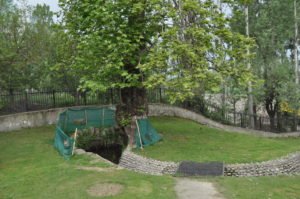
Heemal Nagrai park in Shopian (Photo: Burhan Mir/ZL)
The next day, Heemal notices that somebody has taken a bath in her spring. She questions the guards and maids, but no one has seen anyone coming or leaving. This continues for a few nights. Finally, frustrated by their incompetence, she decides to keep a secret watch over the spring herself. Incidentally, it is a full-moon night. Naagrai arrives as per his new routine and takes off his clothes. When Heemal sees him plunging into the water, the tiny droplets of the splash awaken a whole sky of stars on her body. She instantly falls in love with Naagrai and sets a maidservant after him to find out who he is and where he lives. The maidservant returns with the information that Naagrai is the son of an honourable Brahmin, Soda Ram. Heemal is delighted that he comes from a worthy family, for she knows that will make it easier to convince her father to marry them.
Her father, the king, refuses at first, but she is adamant and he is forced to surrender to the coy look in her eyes. Heemal and Naagrai are married and would have lived happily ever after if fate did not have something else in store. Things change when Naagrai discloses his real identity to Heemal.
The Many Versions of Love
Here the versions start to split. In one telling, when Naagrai shows Heemal her true form, she is terrified, but then he converts back into his human form and assures her that he will never let any harm come to her. She has already fallen deeply in love with Naagrai and trusts him. He makes her understand that she cannot reveal his true identity to any of her human companions because they would never understand the situation. She promises to do so, but once, while her maidservants are combing her hair, looking for lice, she blurts out that her beloved husband is actually a transmogrifying serpent.
A secret shared is a secret lost. Soon everyone in the palace knows the truth about Naagrai. The king sends his soldiers after him and they hack him to death with their axes even as he tries to escape into a spring.
In a slightly different version, Heemal does keep the secret but one of her maidservants discovers Naagrai’s true form herself and informs the soldiers, who then proceed to hunt him down with their axes. In both these versions, when Heemal sees Naagrai’s dead body, her mind leaves her and she follows it, wandering the rest of her life through the forests of Kashmir, looking for her Naagrai in every nook and spring.
In another version, Naagrai, the serpent king, already had many wives when he was discovered by Soda Ram. When he comes to the surface to look at the realm of men, and stays for many years first as the son of Soda Ram and later as Heemal’s husband, his wives are inconsolable on his long disappearance, and rummage through the whole realm of serpents and men looking for him. They cannot locate him while he lives a life of relative anonymity at Soda Ram’s humble abode, but when he marries Heemal with much fanfare, they discover that their beloved Naagrai has married a human princess and rage abundantly. They resolve to get him back and concoct a plan to achieve this aim.
Then they set to execute their plan. First, one of the serpent wives, disguised as a hawker, visits Heemal’s palace, peddling golden vessels at throwaway prices. Heemal is pleasantly surprised by the inexpensiveness of such beautiful vessels and buys quite a few. When Naagrai returns home in the evening, she cannot wait to show him her economical purchases. But one look at the snake embossments on the utensils and Naagrai realizes what mischief his serpent wives have been upto. He throws out the vessels angrily. Heemal is shocked by his reaction. With angry tears welling up in her eyes, she demands to know the reason for such behaviour. He expresses his inability to reveal his motives, but pleads with her to trust him to tell her everything at the appropriate time. When Heemal is placated, he makes her promise that she will not fall for the cheap tricks of strangers in the future.
Hemal Nagrai spring in Shopian (Photo: Burhan Mir/ZL)
Her promise is put to test soon enough when a second serpent wife visits Heemal in the guise of a cobbler. She starts to bawl outside the palace gate. Her cries reach Heemal’s ears who orders her soldiers to show the wailing woman in. She asks her the reason for her grief. The cobbler replies that she is looking for her lost husband who was last seen by someone entering the palace. Heemal asks for her husband’s name. The woman replies that his name is Naagrai. Heemal is taken aback, but maintains her composure and tries to correct her by emphasizing the absurdity of such a claim, because the only Naagrai living in the palace is her husband. But the woman insists that Naagrai is, in fact, her husband. Heemal rejoins that her husband Naagrai is a Brahmin and the woman’s husband must be a cobbler like her. The woman refuses to believe that there could be two Naagrai’s, one a Brahmin and the other a cobbler, since it is such an unusual name, and urges Heemal to confirm the caste of her husband. She proposes that this could be achieved by making her so-called husband go through a trial. She requests Heemal to make Naagrai take a bath in a spring full of milk—if he were a cobbler, his body would float in the milk, but if he were a Brahmin, his body would sink. Heemal is swayed by the spellbinding words of the serpent queen and decides to make Naagrai undergo the ordeal.
When Naagrai returns that evening, she asks him about his caste and insists that he undergo the trial. He understands that it is all the doing of his serpent wives but there is nothing he can do, all his arguments fall on Heemal’s deaf ears like chinar leaves against a glass wall in autumn. He has to concede to fate.
When he steps into the spring, the milk comes up to his thighs. The serpent wives grab him by his ankles and try to pull him down into tal-pataal. But he stands his ground and asks Heemal if she is satisfied. She shakes her head. Gradually, he walks deeper and deeper into the spring till the milk begins to touch his chin. Many times, he asks Heemal if she is satisfied, but she just keeps watching him. Soon his mouth and nose are submerged. A heavy plea tries to fly from his eyes to Heemal’s heart but fails to lift itself. Finally, just before he is about to sink completely, Heemal springs after him and tries to grab him by his hair. But it is too late. The plan of the serpent wives has worked. They have grabbed him by his legs and drag him into the underworld, leaving Heemal only a tuft of his hair.
Heemal is heartbroken. She can now see how distrust led to the loss of her husband. In absolute grief, she completely abandons the world. She gives away all her gold and riches and spends the rest of her days wandering in forests, planting Naagrai’s hair from the tuft she has, and gazing at her sad reflection in springs. In time, Naagrai’s hair grows into pine trees—tall, straight and proud.
This is where this version of the story ends. In another version, after Heemal has given up all her riches, she is left with only a golden mortar and pistil. At this point, a poor man and his daughter visit her. She tells them her sad tale. They are moved by her misfortune. She even shows them the tuft of Naagrai’s hair. Upon seeing it, the daughter remembers something and whispers in her father’s ear. Heemal looks on.
Naagrai khatsao aadam chaalee
Bael poore nun drav trovness ghah
Zaat heveth go tass Heemalee
Maehav gots baalee cheon deedaar
Shams Faqir
As you would have no doubt...
The final version of the story ended in our last issue
Naagrai khatsao aadam chaalee
Bael poore nun drav trovness ghah
Zaat heveth go tass Heemalee
Maehav gots...