
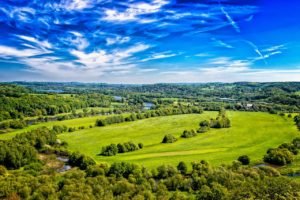
Anyone who has visited the valley of Kashmir must have observed lower mountain-like deposits present almost everywhere. Those are called Vudr in Kashmiri language and Karewas in English. Vudr are an inter mountain valley fill comprising of unconsolidated gravel and mud.
Vudr can be found almost in every part of the valley, as these occupy about half of the valley’s ground. There are more than thirty Karewas in our valley. Though they are occasionally surrounded on all sides by the lower grounds, some of them have their one side flanked with one of the mountains that wall the valley.
One of the longest Vudr runs for about eighty kilometres in length, from Kulgam in the Southeast to Sopore along the Eastern stretch of the valley and it varies in width between13-25 kilometres. However, they can be smaller than a kilometre in length and width, such as on the right side of the Jehlum where they are distributed in an artistic pattern not unlike table beds. Ravines dissecting various Vudr have unique structural features. These were bifurcated by the mountain streams and local drainage systems.
Vudr found along the borders of Pir-Panjal mountain range are sloping in shape and form. This type of Vudr are found in Kulgam, Shopian, Budgam, Qazigund, Raithan, Tangmarg, Gulmarg, Bota-Pathari, Nagum, Kholyan, Arigam and Baramullah.Meanwhile Vudr with flat tops are few in number, gradually consist of horizontal beds and can be found on the right side of the Jehlum, i.e, in the Eastern half of the valley. The important flat topped Vudrs are found in Mattan, Islamabad, Bejbehara, Awantipora, Letpora, Chandhara, Zewan, Khrew, Tral, Safapora, Soura and Ganderbal.
Vudr are home to unique biodiversity. The famous almond orchards are best grown in the soils of Vudr. The negligence of the concerned authorities has caused irreparable loss to the unique biodiversity of Kashmir. Vudr extending over a vast area, exhibit different structural features at different locations and at different depths. Upper Vudr are mostly horizontally stratified deposits and composed of the beds of fine grained sand, loam and blue sandy clay.
The agrarian importance of the Vudr cannot be underestimated. The best qualities of commercial and cash crops of Kashmir, like saffron, almonds, walnuts, apples, apricots, etc., flourish in the lower Vudr. Among such crops, almond and apple occupy larger parts of the arable land.The higher reaches of the Vudr are generally under maize cultivation, and wherever the irrigation is possible, paddy is cultivated.
In Pompore and its adjacent areas, flat-topped Vudr are widely distributed and rise up to 75 meters above the valley floor and near Anantnag their height is almost the same. The Pampore Vudr is famous for its saffron cultivation. This crop is preferably cultivated on Vudr due to the minimal chances of water-logging that can damage the quality and quantity of saffron to a great deal.
Vudr possess a good amount of mineral wealth as well. According to the Geological Survey of India, there are Liginite coal deposits of about 5 crore 60 lakh tons in the valley scattered in places like Nichahama, Baramulla, Handwara, Chowkibal, Ferozpur Nullah, Nagbal, Tangmarg, Badgam, and Lolab Valley, with all these places being rich in Vudr from where the coal resources are derived.
Some small pockets of salt-petra (potassium nitrate) are found occasionally in some of the upper Vudr. High above in the Vudr, in spring water, sulphur is found in places like Anantnag and Khrewa, at estimated deposits of about 2,00,000 tons. Also, Gypsum deposits are found in the places like Lachipora, Baramulla, Liddipora and Kathia Nullah.
Lime stone deposits are also found in the Vudr of Anantnag, Achabal, Doru, Verinag, Biru, Sonmarg and Khrew, while copper ores are found in Karewas of Aishmukam, Shubbar area of Anantnag, Handwara, Sumbal, Kangan and Lolab Valley.
There is a special type of pebble found in most of the lower Vudr that forms good lime.An excellent chalk is obtained from Vudr near Srinagar, and is known as ‘Sipar’. It is used for wall plaster and also for writing on slates. Some small pockets of salt-petra (potassium nitrate) are found occasionally in some of the upper Vudr. There are also some reserves of the lignite embedded in Vudr.
Also Read: ODE FOR A SAD LITTLE DOVE
The most important of all the items of Vudr is their clay, which is rich in various constituents. It is mostly suitable for pottery due to its rich humus constituent. The clay pots produced at Zewan, Tsrari-Sharief, Ompora, Pakharpor, Tral and Lethpor are famous throughout the valley. The common articles made from that clay are earthen cups, plates, vessels, kundals (small pots used inside Kangries to prevent heat from burning it).
This rich fertile soil is being used for landfills at construction sites that are not only a waste of resources, but also a threat to the environment, taking into account the high seismic zone the valley falls into. The rampant anthropogenic erosion since a couple of years has reduced these plateau lands into ugly ravines. More than now, we need to preserve this geological treasure as a legacy for the generations to come.
Advertisement