
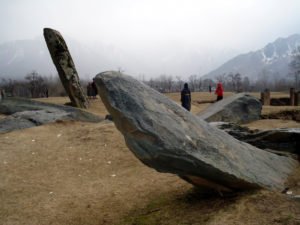
The story of housing in Kashmir is ancient but its discovery is very recent. In 1935, two archaeologists Helmunt de Terra and Thomas Paterson, leading a team of experts from Yale-Cambridge on an India expedition, found big stone-like structures called menhirs in the small village of Burzohom outside Srinagar city. They knew immediately what it was and what it could lead them to. When they began to excavate in the village, they found small tools and bones.
Although it was a short excavation, it brought attention to the pre-historic period of Kashmir. More and more excavations followed in the coming decades and it brought to light how early Kashmiris lived and what kind of people they were. Scientific evidence tells us that the prehistoric humans lived as wanderers; wherever they found food, that became their habitat. In Kashmir, they often lived at higher places like Gulmarg, Shopian and Pahalgam and moved in and out of the valley.
To understand fully about the lives and times of these earliest dwellers in the valley of Kashmir, Burzohom offers important insights. But one should take note that Burzohom was not the only place where these aborigines lived. In fact, archaeological evidence has been uncovered for places like Gofkral, Pampur, Panzgom, Sombur, Thajiwor, Olichibagh and Waztal all located on the Karewas or what in Kashmiri are called Vudr.
Excavation in Burzohom showed that there were four periods of this culture. Out of the four periods, the first two periods belong to Neolithic ages and the later two belong to Megalithic and early historical period respectively.
In the first period, we see how early humans dug up the earth so as to use it as a dwelling place. Mostly drawn in circular or square shapes, these pits were wide at the bottom getting narrower towards the top. They were approximately 12 feet deep, 15 and 9 feet wide at the bottom and top respectively.
The tops were covered by birch leaves and supported by wooden planks amply demonstrating that these pits were roofed structures.
To descend into the pits, steps had been cut into the soil. As one descended into the pit, the steps disappeared so as to increase the living space of the ‘room’.
From evidence gathered by archaeologists, it is assumed that these pits were used by early settlers for battling the severe winters of Kashmir or under bad weather conditions. They also lived an open air life. Corresponding to these pits, another type of ‘house’ was also constructed. These had wide bases but were often only three feet deep with roofed structures. Both were used for residential and storage purposes and were mud plastered. These pits were interconnected to each other through an arched corridor.
At the mouth of the pits, a stone hearth or clay hearth was erected for cooking purposes. But such hearths were also placed inside and outside the pits. However, as there is absence of soot on the walls, one can surmise that the hearths inside the pits would have been used for other purposes like speeding up drying of the mud-plaster.
A stunning transformation is seen in the architecture of the houses of these people in the second period. Instead of living underground, they began to move outside and constructed mud and mud-brick houses. Reusing the pits from the previous period by filling them with mud, floors were laid out, with rammed soil and with a thin layer of red ochre being used possibly as a finish. Timber was extensively featured in these houses to provide strength and shape.
It is hard to tell what kind of religious beliefs these people had, but an important thing that has surfaced is the lack of image or icon worshiped by the people of this region. Further, they dug up graves for their dead in a proficient way, often under the floor of their own houses.
And what did they eat? With every prehistoric community, hunting wild animals and eating their meat was a widely known practice. Neolithic communities in Kashmir extended their gastronomic habits by cultivating wheat, lentils and barley.
The other two periods that is Megalithic and early prehistoric periods saw advancement in the construction techniques of houses. Excavations have showed the introduction of wheel based pottery. In addition different types of tools are found in the later phases made of copper and iron which shows both knowledge of metallurgy and contacts with different cultures of Central and Western Asia. Megalithic periods also saw the emergence of menhirs—a total of eleven structures.
Burzohom clearly demonstrates how aboriginal Kashmiris had a certain degree of advancement when it came to construction and architecture of houses. This perhaps shapes our current understanding of urban and rural planning where we, as a society, are mainly concerned with building houses.
This is not a problem per se, but looking at the Burzohomese and their adaptability to the environmental conditions, it is vital to indigenise our architecture. Rather than adapting the concrete and glass patterns borrowed from other cultures, we should focus on Kashmir centric techniques especially since our rich history hasn’t failed in offering us the best lessons.
Advertisement