
History always begins with a when and a where. When we ask“when and where exactly did that happen?”, we are asking for answers and specificity grounded in history. History lights our way back to a point of origin, towards a discernible source. We ask old people to tell us what they remember from days past. We read books written by people who are already dead. In this way, we light up the path to be able to walk back towards our past.
Now, let us reach back to thousands of years and discover where and when it was that the days were each given a name. Or ponder for instance upon the question of who first had the idea of arranging them into weeks.
Picture a country of high temperatures thatat the same time is often wet, crossed by two rivers, the Tigris and the Euphrates. The important part of this country lies between these two rivers that at some point join together and then flow out into the Persian Gulf. And because the important part of the said country lies between two rivers, it is called Mesopotamia, which is Greek for the land “between the rivers”. Mesopotamia is in Asia, in a region called the Middle East, in the country of Iraq.
Here you will find high walls that look more like hills but when you dig deeper into them, they aren’t hills at all. Inside these hills lie the ruined towns and great citiesthat cracked and crumbled over time and eventually collapsed into great mounds of rumble. In the past, explorers have also found a great number of tombs packed with the most astonishing treasures. Some of these treasures can be seen in the British Museum in England, and others in the University of Pennsylvania and in the Museum of Baghdad in Iraq.
Mesopotamia was ruled by many tribes and kings, who held power at different times. The most important of these were the Sumerians, the Babylonians (with Babylon once being the greatest city on earth) and the Assyrians. In some respect, the Sumerians were ahead of all these. The ancient Sumerians were great traders. The Babylonian and the Assyrians after them were disciplined and hardworking.
Both the Babylonians and the Assyrians worshipped Baal (the sun God), Ishtar or Astarte (the moon goddess) and the stars. During nights, over centuries, they used to observe and record everything they saw in the skies. They noticed that the stars revolved in a regular way. They soon learned to recognize those that reappeared each night in the same place in the skies. Most of the stars stayed fixed to the skies and it seemed miraculous to them. And they saw shapes in the constellations and gave them names.
Today we know that these are the stars that turn with earth around the sun. They are called planets.
The ancient Babylonians and the Assyrians couldn’t have known that, so they thought that some magic must lie behind such phenomena. They gave a name to each wandering star and observed them constantly. They became convinced that these stars were powerful beings and their positions influenced the destinies of men, and that by studying them they would be able to predict the future. This belief in the stars has a Greek name: astrology.
Also Read: VUDR: THE KAREWAS OF KASHMIR
Some planets were believed to bring good luck, others misfortune. Mars meant war and Venuslove. To each of the five planets known to them, they dedicated a day, and with the sun and the moon, that made seven. This was the origin of our seven-day week. In English we still say Satur( Saturn)-day, Sun-day, Mon(moon)-day, but the other days are named after different gods.
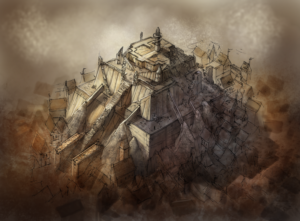
To be nearer to their stars, and to see them better, the Babylonians, and the Sumerians before them, erected strange buildings in the form of broad towers with a wonderful name: Ziggurats. Right at the very top was a temple dedicated to the moon, or to one of the planets. People came from far and wide to ask the priests to read their fortunes in the stars, and brought them offerings of great value.
Advertisement