
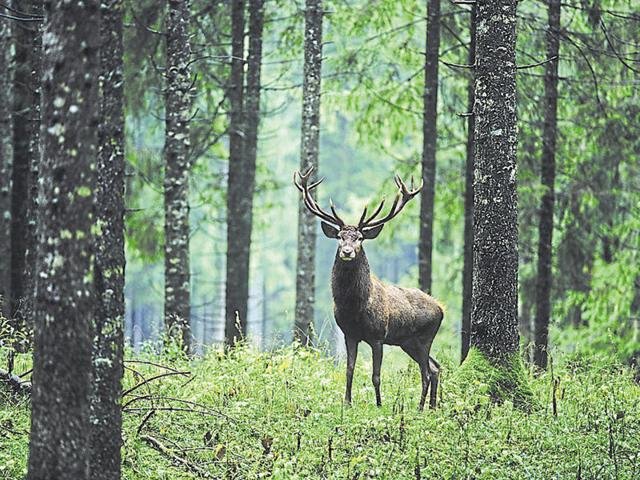
As per the Bombay Natural History Society, Kashmir’s Hangul population numbered 3,000 to 5,000 around the year 1900. After that, population started shrinking drastically and its movement remained confined to Dachigam Park. Earlier Hanguls were seen in and around entire kashmir valley, Chinab valley and Ladakh.
However, 2015 census carried out by Kashmir’s forest department estimated it could be at its lowest ever, 110-130, in Dachigam. There are other reports which suggest that the population in 2015 was 186, perhaps this report counts Hanguls across the J&K but it also suggests that Hangul population is confined only to upper Dachigam area of 1000sq. KMs.
In March, 2017, the population – as per the minister for Forest and Ecology – stands at 182. The discrepancy in the reports also shows how serious the government is in conserving the “state” animal of J&K. The decline is blamed on fragmentation of forested habitat, land encroachment for grazing and elite hunting.
Moreover, in spite of its statement in 2016, the IUCN (International Union for Conservation of Nature) is yet to declare Hangul a ‘critically endangered’ species.
The magnificence of Hangul lies in its giant antlers bearing 11 to 16 points.