
Today is 21st December, the first day of Chillai Kalan– a period of forty days when Wande turns into occupier. In this season, the days are shorter and nights more extended, and the primary source of heat and energy, Sun remains mostly disappeared in the clouds.
This season is so harsh that it restricts civilian activities and keeps them house–arrested for the most part of the day. As the frequent encounters of snow blanket the valley, the biting cold-breezes hit people like pellets on the exposed body parts with feet and ears being the first casualties of shuh (frostbite). The mist and fog attack the eyes, not unlike pepper and tear gases.
The mufflers are more used to wipe noses than to warm necks and shoulders. Double layered woollen or fleece caps are pulled down to the ears. The young boys and girls get their first training of sheen–Jung no sooner did the shelling of snowflakes hit the ground. When the batons of shishergaent (icicles) unleash their power, the gloves fail to prevent the skin from turning into blue.
Kanger remains the only assault–rifle with pheran acting as a bulletproof vest to brave the chilia kalan onslaught. If it were not for this armoury, every civilian in Kashmir would freeze like an Over Ground Worker (OGW). To ban a bulletproof vest is like prohibiting the rebels from breaking the cordons of chilia kalan.
Pheran
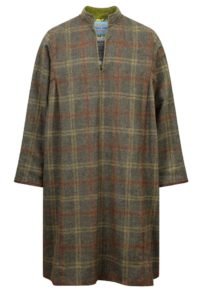
A traditional garment of the Kashmiri people, it is a loose top that falls to the knee length. Made up of wool or tweed, it shields a body from the biting cold and is often worn with a Poas under or attached to it- a khadi-garment of a pheran size that protects the pheran against the bright embers of kanger. Pheran is among those few things that have become synonymous with Kashmiri identity.
Kashmiri women wear embroidered (tildar) Pherans at different occasions –marriages, social functions and even on funerals –and of varying fabric mostly of velvet, tweed, Cotton et al. These Pherans are collarless with no side slits and mostly have a replica of folded sleeves (qorab).
Kanger
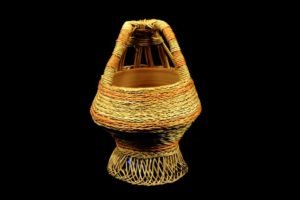
A fire-pot used under a pheran, shawl or a blanket to keep the body warm during the coldest days. It is made by weaving wickers around an earthen pot (Kondal). It is filled with burning embers (Tchene) and sawdust-ashes. During fights and conflicts, kanger thrown at a 45⁰ angle acts as a Weapon of Mass Destruction for hot-headed khadpenches (people who mediate the disputes) or fighters. Besides ashes and embers, a stroke of a kondal could shift any person to a hospital.