
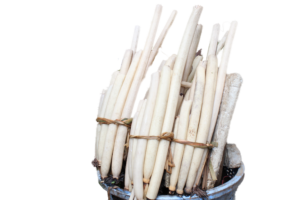
Nadroo, commonly known as Lotus root, is actually a modified tuber. Nadroo is widely distributed in South-East Asia and in Kashmir valley. It grows naturally in two famous lakes, Dal Lake and Wullar Lake, Dal Lake is located in Srinagar while the Wular Lake is Located in Bandipora.
Nadroo has a dim white crunchy flesh with a mild sweet water chestnut-like flavour. Its roots remain attached to the muddy layer of the water body, developing a rhizome. The rhizome forms into cylindrical shaped three to five jointed nodes of about 2-4 feet in height, with leaves of 40 to 55 cm sprouting over the surface of the water.
The leaves of Nadroo are called ‘Khel’ in Kashmiri and have been used for domestic purpose. Towards the end of the growth cycle, one of the widely recognised and mesmerizing flowers called Lotus, with diameter 15 to 20 cm, grows above the water surface. These flowers add charm and beauty to the surface of the lakes.
After pollination, a seed of 1cm diameter gets developed in Nadroo flowers. These seeds remain located in the woody vessel which does not look unlike a showerhead. The division of these seeds and rhizomes propagate Nadroo.
There is a famous myth all around the valley that the Nadroo threads are in fact the yarn threads that Lalla Ded (1320-1392) threw into the Dal lake when her tyrant mother-in-law ridiculed and taunted her for yarning the thread too thin.
Nadroo harvest begins by October and lasts till the month of December.This is a tough job as one has to go deep into very cold mud or waters (-2 to 9 C) for its extraction. It is then supplied to the whole valley.
Nadroo also grows in Jammu and has been brought to the valley for selling, but the Nadroos of Dal and Wullar Lake have a unique taste and colour.
The Nadroo plant has some unique features like the ability to regulate the temperature of its flowers within a narrow range, seeds with long viability periods and in addition its leaves show the lotus-effect, known as the self-cleaning property.
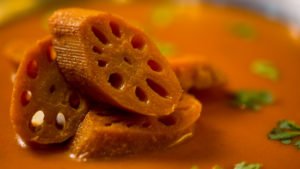
Recipes: Nadroo is one of the recipes of traditional Kashmir cuisine (Wazwan) and is also cooked in homes. Nadir-Yakhin is famous throughout Jammu and Kashmir and it can also be mixed with spinach and pulses.
One of the popular street foods locally called Nad’ir-Munjee is famous throughout valley. Pickles made of Nadroo are also prepared in Kashmiri homes and sold in the market.
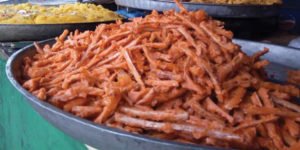
In other Asian countries,there are many forms and products derived from Nadroo, among them variations of the food in fresh and salted form as well as drinks and teas, among other popular items. In China and Japan, raw or roasted Nadroo and seeds are extensively consumed as food, while seeds are also used as an ingredient in a large number of pastries and desserts.
Medicinal Value: Various part of Nadroo like buds, flowers, anthers, stamens, fruits, leaves, stalks, roots are used as herbal medicines for the treatment of many ailments including depression, diarrhoea and heart problems.
It is also used to treat sunstroke, dysentery, and dizziness, vomiting of blood, uterine bleeding disorders, fever, urinary problems, nervous disorders, insomnia and epitasis, and for improving the skin condition.
Nadroo seeds are used as spleen tonic and its seed powder is used to cure cough. For other diseases, Nadroo remains useful to cure hypertension, cancer, weakness, and body heat imbalance, consolidation of kidney function, stopping bleeding and to eliminate the stagnated blood.
Also Read: HAAKH: Food Value and Medicinal Benefits
Nutritional Value: Nadroo is rich in starch,vitamins including vitamins B1, B2, B3, B5, B6, B9, B9, and C. Also, apart from Fiber and Protein, it is rich in minerals which include Calcium, Magnesium, Carbohydrates, Sugars, Manganese, Phosphorous, Potassium, Sodium, Zink, and Iron.
Advertisement