
Ramadhan is the ninth month of Islamic calendar. During this month, Muslims observe fasting from dawn to dusk. Zaid Bashir captured some beautiful movements observed during the month.
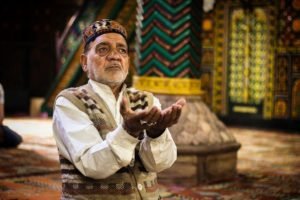
A Kashmiri Muslim prays inside the Khankah mosque. Khankah is one of the oldest mosques of Kashmir, named after Syed Ali of Hamedan, the pioneer of Islamic propagation in Kashmir.
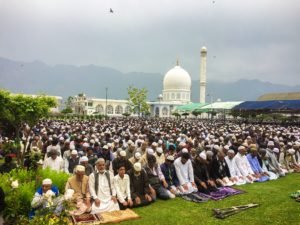
Kashmiri Muslims gather offering prayer at Dargah Hazratbal shrine, Srinagar. The Dargah shrine contains a relic, the Moi-e-Muqqadas, believed by many Kashmiri Muslims to be a hair of prophet Muhammad (PBUH). The name of the shrine comes from the Urdu word “Hazrat”, meaning “respected”, and the Kashmiri word “bal”, meaning “place”. As such, it means a place that is kept in high regard and is respected among the people.
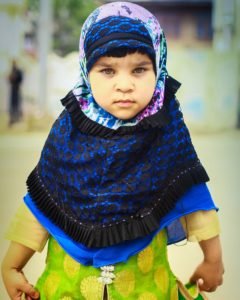
Khateeba, 5 years old, on the 4th day of Ramadan stands in the compound of the Dargah Hazratbal shrine, Srinagar.
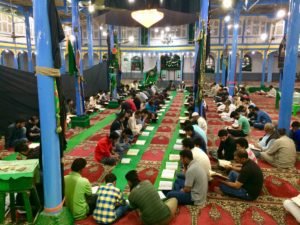
Kashmiri Muslims recite the holy Quran during the holy month of Ramadan at Imam Barah Hassanabad, Srinagar. Built in 1857, Imambara Hassanabad is the second oldest shrine in Srinagar. Situated in the south-west side of the city, this shrine sits in the middle of three other religious places that include the Chatti Padshahi Gurudwara, Hazratbal Mosque and Maa Sharda Devi Temple. The architecture of the octagon-shaped Imambara Hassanabad showcases an Indo-Iranian style of construction. Around five main entry gates to the shrine are reserved entirely for women. The Baba Mazar, a Mughal graveyard, is also situated close to this shrine. Famous Kashmiri luminaries such as Baba Ali, Hab Saheb Mulla, a renowned poet of Kashmiri Marsia, and Syed Mirza Shah, the great Persian poet of the 17th century, used this cemetery as their resting place.
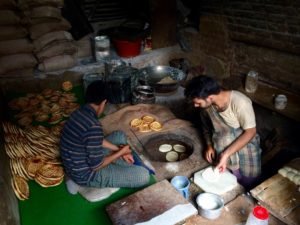
Kashmiri baker boys produce traditional bread added with ghee at a bakery shop in downtown, Srinagar. The traditional bread of Kashmir is popularly know as Ghyev Czhot, which is made with an added ingredient, ghee, to make it more delicious and is then baked in a tandoor (oven). It is specially made during the holy month of Ramadan.
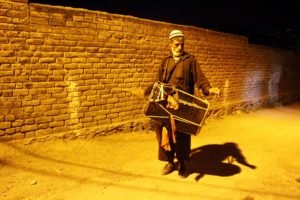
During Ramadan People in Muslim majority Kashmir awakened for pre-dawn meals by a person called Sahar Khan, who beats a drum in every locality. This is a centuries old tradition but many believe it won’t be taken ahead by coming generations. Manzoor Lachi, 60-year-old Sahar Khan beats his drum as he walks through the streets of his neighborhood to awaken people.
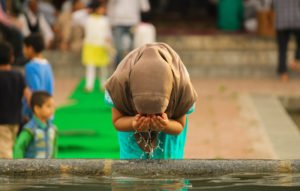
A Kashmiri Muslim girl performing wudu (ablution) before prayers at the fountain in Historic Jamia Masjid, Srinagar. Wudu is the Islamic ritual for washing parts of the body, a means for purification before offering prayer. Wudu involves washing the hands, mouth, nostrils, arms, head and feet with water and is an important part of ritual purity in Islam. Wudu is typically done in preparation for formal prayers (salat) and also before touching, holding and reading the Quran.
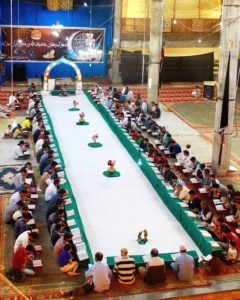
Believers recite holy Quran during the month of Ramadan at Imambara Zadibal, Srinagar. Imambara Zadibal is the first Imambara constructed in Kashmir valley by Kaji Chak (minister in the regime of Sultan Mohammad) in the year 1518. Inspired by Persian style architecture, Imambara Zadibal is a two-storey building. It is constructed with oriental bricks and it is supported by Maharaji bricks that cover an area of over 75 square meters. Antique and striking, this shrine has various sideways floor raising known as Gulam Gardish. There is a central ground level floor called Pokhr. It also houses a large gallery of four gates. The shrine has the unbelievable capacity to accommodate more than 32,000 visitors at a time.
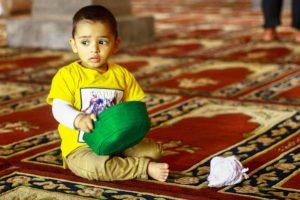
Eight month old Abdullah rests inside Historic Jamia Masjid (mosque) during the holy month of Ramadan, Srinagar. Jamia Masjid was built by Sultan Sikandar Shah under the order of Mir Mohammad Hamadani. It was constructed in persian style and designed to hold 33,000 people besides the Imaam at a single prayer congregation.
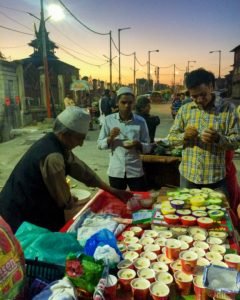
A vendor sells Phirni during Iftaar (meal eaten by Muslims after sunset during Ramadan), in downtown Srinagar. Kashmiri Phirni is made with semolina (suji) cooked in milk and sugar. It is flavored with cardamom, raisins, saffron, cashews, pistachios and almonds. Phirni is a favorite among Kashmiris during the month of Ramadan. The majority of the Kashmiri Muslims consume Phirni during this holy month.
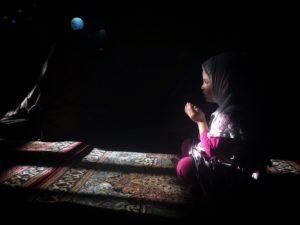
A Kashmiri girl supplicating at Khanqah-e-moula mosque located in the old city of Srinagar. Globally, Muslims fast in the holy month of Ramadan. They abstain from eating and drinking from dawn to dusk. Muslims perform extensive supplication in the holy month of Ramadan. Apart from keeping fast, the objective of Muslims in this month is to gain as many blessings and rewards from Allah (God) as possible.
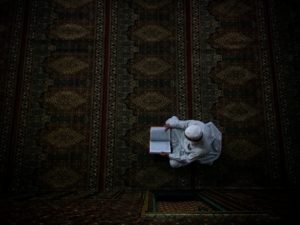
A Kashmiri Muslim recites the Quran during the holy month of Ramadan at Khankah-e-Moula masjid (mosque), Srinagar. Khanqah-e-Moula, also known as Shah-e-Hamadan Masjid and Khanqah mosque, is the first historical masjid in kashmir recognized as the point of departure from which Syed Ali Hamadani started preaching Islam to Kashmiris. It is located in the Old City on the right bank of the river Jhelum between the Fateh Kadal and Zaina Kadal bridges. First built in 1395 AD, it is the oldest mosque in the Kashmir valley and one of the best examples of Kashmiri wooden architecture, decorated with papier mache.
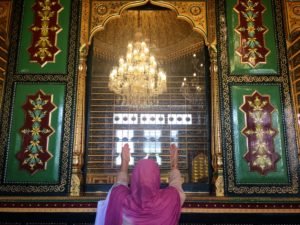
A Kashmiri woman prays at Dastigeer shrine during the holy month of Ramadan in Srinagar. The Dastigeer shrine hosts an old Quran transcribed by Hazrat Abu Bakr Sidiqqi, Hazrat Ali, and the Mouia Pak, a piece of hair from Gous E Azam. It was constructed in 1806 and expanded in 1877 by Khwaja Sanaullah Shawl. It is the center of the activity hub of Khaniyar and is surrounded by a large market. On the Urs of the Gous E Azam thousands of people from all over Kashmir come to pray to Allah and watch the Ziyarat. There are five graves situated inside it, one of them being the grave of one of the members of Sheikh Syed Abdul Qadir Jelani’s family.
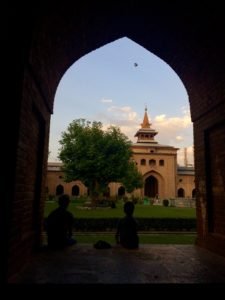
Kashmiri boys rest on a stone-laden surface on the window of the Grand Jamia Masjid after evening prayers during the month of Ramadan, in Srinagar.
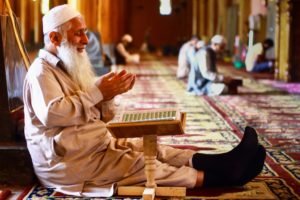
A Kashmiri Muslim supplicating after reciting the holy Quran following Zohr (afternoon) prayer during the month of Ramadan at Historic Jamia Masjid (mosque) in downtown Srinagar.
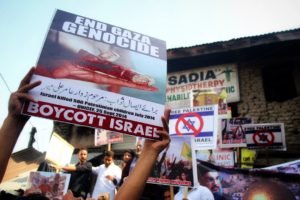
A Kashmiri protestor holds a placard during the pro-Palestine protest to mark the international Quds day at Zadibal in Srinagar on June 8, 2018. The Quds day is observed on the last Friday of Ramadan every year to express support for Palestinians and condemn Israel. The Quds day protest was initiated by Iranian revolutionary leader Ayatollah Khomeini in 1979 to show support for Palestine and oppose the illegal Zionist occupation of Palestine.
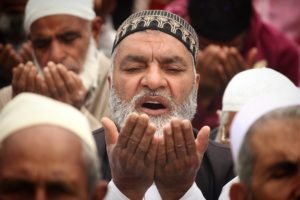
A Kashmiri Muslim supplicating during the last Friday (Jumu’atul-Widaa’) prayer of holy Ramadan at Dargah Hazratbal shrine in Srinagar. Jumu’atul-Widaa is the last Friday of Ramadan. Jumu’atul-widaa is very highly regarded by all the Muslims around the world.